The New South Wales’ South Coast has a profound sense of home. This locale, bearing the imprint of tens of thousands of years of habitation, presents an idyllic vision of life. Yet, intertwined with its serene beauty is a tapestry of trauma. The displacement of indigenous populations marks one layer of trauma. More recently, its new inhabitants have faced the ravages of fire and flood. Despite these scars, Lake Conjola remains a haven of comfort and joy.
“My work aims to capture something that challenges perception.
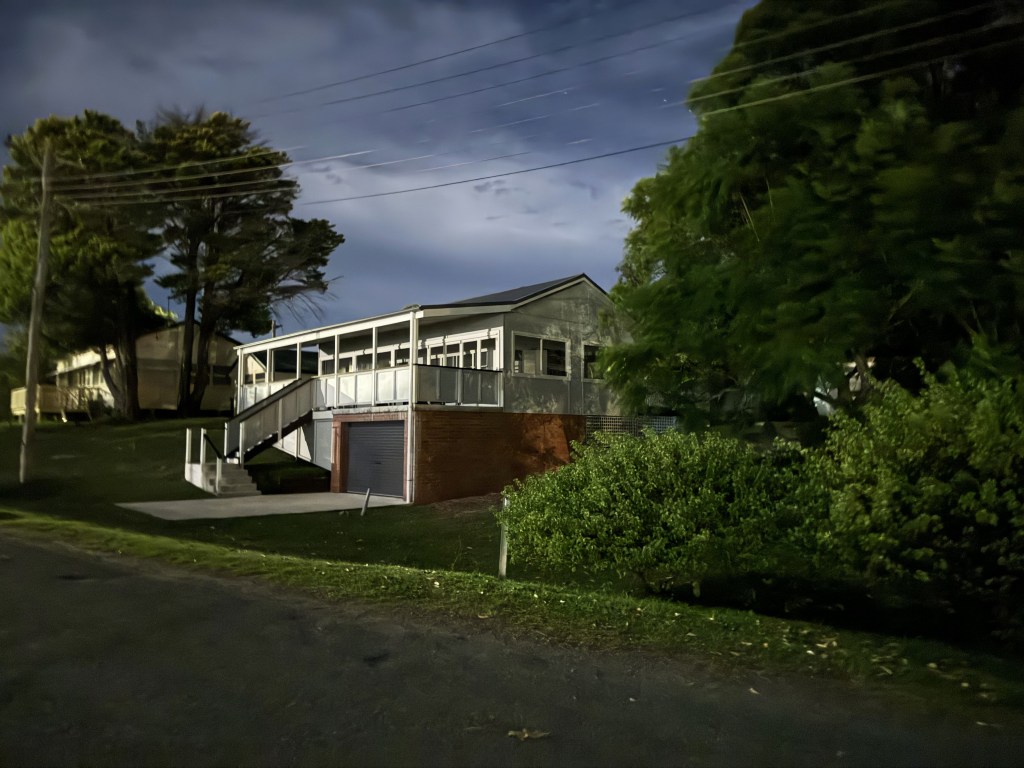
It is easy to view this place purely through the lens of its beauty, whereas as images like this juxtapose an uncanny sensation. Reflect the layered history of trauma.
This is a photograph of a reality, yet it possesses an almost unreal quality. This interplay could be termed “truthful fiction,” Inspired by Magritte’s investigation of nature’s paradoxes.
Sometimes I feel like I am screaming silently in the dark.”
ABOUT MAGRITTE
Rene Magritte’s subversion of reality, the unsettling juxtaposition of the dark street scene beneath the intense sky. The shadows clash with the perception of night time creating a disquieting paradox
Here Woodward also finds the familiar upended; the light of the house serves as a beacon of daylight, typically a symbol of clarity and understanding. The depth of colour above, rather than offering solace, amplifies the dissonance, rendering the bright light below even more unfathomable. The otherwise normality of the scene heightens the tension, the ordinary is transformed into something deeply disconcerting. This uncanny blend of day and night fractures the expected order, leaving the viewer suspended in a world where the boundaries between light and dark, known and unknown, have been blurred
There is the obvious influence of Magritte’s exploration of paradox and perception, the pre-Kosuth inquiry into the nature of perception and semiotics. To question what and whether an image is real or a real representation, prompting a deeper contemplation of the symbols and representations that shape our understanding of reality.
Another enduring influence on Woodward’s practice is Julia Margaret Cameron. A revolutionary, the emotional impact of her work using new technology in her own way to evoke scenes and personalities. She wasn’t precise, and didn’t use the camera in the way that she was ‘supposed to’
FAILURE
The influence of Magritte on Sarah’s practice started when she was young. An attempt to recreate Golconda for her Photography A Level was an abject lesson in failure. (The final submission completely changed direction and started her focus on place and scale).
“That failure still sends shivers down my spine, a reminder of the time I felt I had wasted. It has taken much more time and reflection to recognise that with each iteration, I keep improving.
I’ve come to realize that this process—of striving for excellence—is the antithesis of perfection. I will continue pushing forward, embracing failure as an opportunity to reflect, review, change, and ultimately improve.”
FEMALE NAMES IN WORK
“The Ancient Romans upheld “nomen omen” (a name is a sign), and we still believe that a name gives identity and character to the person or object that carries it. …Names interfere with the nature of named objects; in the conceptual … way the object is perceived and received. Names are part of … the object and often, hidden behind the name, are stories that are worthy of exploration.”
There are interrelationships that exist in place. Especially this place. We all exist there; we all have our unique experiences there.
The place, the home.
The home as the feminine, that “A house that has been experienced is not an inert box. Inhabited space transcends geometrical space.” (Bachelard)
LORRAINE AND MANAGEMENT NO BLACK AND WHITE
“Lorraine was my manager, she had made promises—if I did what she wanted, she would ensure my work was recognised. But she didn’t keep her word.
She let me down. When I raised it officially, so that I could get the appropriate pay/grade/recognition she was terrified, she had made an error, but was more concerned about being punished for that, than making amends.”
In the aftermath there was a shift. She has been more conscientious more mindful of her promises and has become a better leader. Leadership is not a binary of virtue and vice, we aren’t simply right or wrong, good or bad, but when we cause harm, we should learn from it, it must inform future actions. and not be repeated.
This land, too, tells a story of promises—of a symbiotic relationship between those who cared for it and the sustenance it provided. Displacement disrupted this harmony Those who took over, though maybe well-intentioned, lacked the knowledge necessary to preserve the place. Their mistakes were evident in the devastation that followed—fires and floods, the consequences of their ignorance. Yet, there is learning here as well, a slow, painful acquisition of understanding that speaks to the potential for redemption. In both cases, the challenge remains the same: to learn, adapt, and ensure that past mistakes are not repeated.
ABOUT PLACE
The place is boundlessly sublime, it just is. The lake. The ocean. The sand, The mountains in the background. Objectively perfect, ‘an agreeable kind of horror’. A place where an imagined and real idea and ideal of home have existed for tens of thousands of years.
But it is also a personal place of reprieve. For me, and I know for so many others, the sense of belonging and peace, that comes through despite the horror of those that have been displaced and had their homeness taken away. Through invasion, fire and flood. Yet we all come back again to find home.
 Sarah Woodward